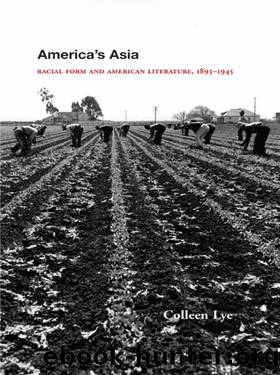
America's Asia by Colleen Lye
Author:Colleen Lye [Lye, Colleen]
Language: eng
Format: epub
Publisher: Princeton University Press
Published: 2009-05-24T04:00:00+00:00
A few migratory workers went back to the land after lean years of wandering and seasonal work. Near Bakersfield Doil Ash, whose Oklahoma âdust bowlâ living blew away in 1935, leased a 26-acre farm from Hido Miwa. If any questions arise, Miwa said, Ash can always write to him.76
In such cases, farm transfer could not be expected to lead to an increase, or to even to the maintenance, of productive efficiency. As an editor at the Nation, Robert Bendiner, observed: âTrained in a tradition of intensive cultivation, [Japanese farmers] have learned to make their few acres yield down to the last square foot. As a rule, moreover, an entire family works a farm, so that even on a strictly numerical basis it would take more than one Okie to replace a Japanese farmer.â77 The competing narratives of evacuee farm transfer as the acceleration of corporate consolidation and as the recreation of small farming opportunities reflect, in a sense, the broader contradictions between the modernizing and nostalgicâas well as the rationalizing and redistributiveâtendencies in the New Dealâs overall farm program.
Furthermore, the FSAâs showcase anecdote of Miwa and Ash points to an unlikely intersection between the Okie and the evacuee, a symbolic relationship that was complexly opposite and parallel. The anecdote allegorizes a point of contact between the New Dealâs modes of address to agricultural crisis and wartime evacuation policy, between Dorothea Lange and Paul Taylorâs emblematic diagnosis of rural displacement, An American Exodus: A Record of Human Erosion (1941) and the social remedies proposed by the WRAâs A Story of Human Conservation (1945). In the figural intersection between Okie and evacuee, was it the perpetual migrant, then, who was the ultimate imaginary subject of wartime human conservation? We are reminded of McWilliamsâs excitement at evacuationâs potential for leading to permanent rural communities that seemed oddly blind to the fact that the West Coast Japanese were already settled. Spatially, the orchestrated movement of 110, 000 people east provided an inverse imageâboth directionally and in styleâto the chaotic displacement of hundreds of thousands west over the previous decade. The transportation of an entire population over the matter of a few months was, as McWilliamsâs sense of marvel communicated, more efficient an exercise of governmental machinery than had been witnessed in earlier 1930s examples of planned resettlement.
Assumptions that such a strategy for addressing the broader Depression- era theme of âhuman erosionâ was also in the interest of Californian soil conservation, however, could not be taken for granted, given the doubtful reputation of the landsâ new occupants, whose agricultural know-howâas even the FSA press release acknowledgedâwas clearly subordinate to the Japanese farmerâs. Though the farm transaction may have been partly evocative of a comforting agrarian solution to the state of perpetual migrancy, installing the Okie as an antidote to the Asiatic, Asiatic and Okie were unavoidably united by a shared association with the predicament of soil erosion. In the 1930s, the disasters incurred by soil erosion throughout the United States, but particularly in Oklahoma and
Download
This site does not store any files on its server. We only index and link to content provided by other sites. Please contact the content providers to delete copyright contents if any and email us, we'll remove relevant links or contents immediately.
| Anthropology | Archaeology |
| Philosophy | Politics & Government |
| Social Sciences | Sociology |
| Women's Studies |
Cecilia; Or, Memoirs of an Heiress — Volume 1 by Fanny Burney(32558)
The Great Music City by Andrea Baker(32019)
Cecilia; Or, Memoirs of an Heiress — Volume 2 by Fanny Burney(31956)
Cecilia; Or, Memoirs of an Heiress — Volume 3 by Fanny Burney(31942)
We're Going to Need More Wine by Gabrielle Union(19046)
All the Missing Girls by Megan Miranda(16029)
Pimp by Iceberg Slim(14508)
For the Love of Europe by Rick Steves(14121)
Bombshells: Glamour Girls of a Lifetime by Sullivan Steve(14076)
Talking to Strangers by Malcolm Gladwell(13370)
Norse Mythology by Gaiman Neil(13365)
Fifty Shades Freed by E L James(13241)
Mindhunter: Inside the FBI's Elite Serial Crime Unit by John E. Douglas & Mark Olshaker(9343)
Crazy Rich Asians by Kevin Kwan(9292)
The Lost Art of Listening by Michael P. Nichols(7506)
Enlightenment Now: The Case for Reason, Science, Humanism, and Progress by Steven Pinker(7313)
The Four Agreements by Don Miguel Ruiz(6765)
Bad Blood by John Carreyrou(6622)
Weapons of Math Destruction by Cathy O'Neil(6281)
